
Origins
The berimbau, a striking and iconic musical instrument, has its origins rooted in the rich cultural heritage of Africa. Brought to Brazil by enslaved Africans during the transatlantic slave trade, the berimbau became an integral part of capoeira, a martial art that blends elements of dance, music, and ritual.
In its simplest form, the berimbau is a single-stringed musical bow made from a wooden arc (verga), a steel wire (arame), and a resonating gourd (cabaça). Despite its simplicity, the instrument produces a range of complex and evocative sounds. It is played with a stick (baqueta), a small stone or coin (dobreau), and often accompanied by a woven rattle (caxixi). These components combine to create the rhythmic foundation for capoeira, guiding its movements and energy.
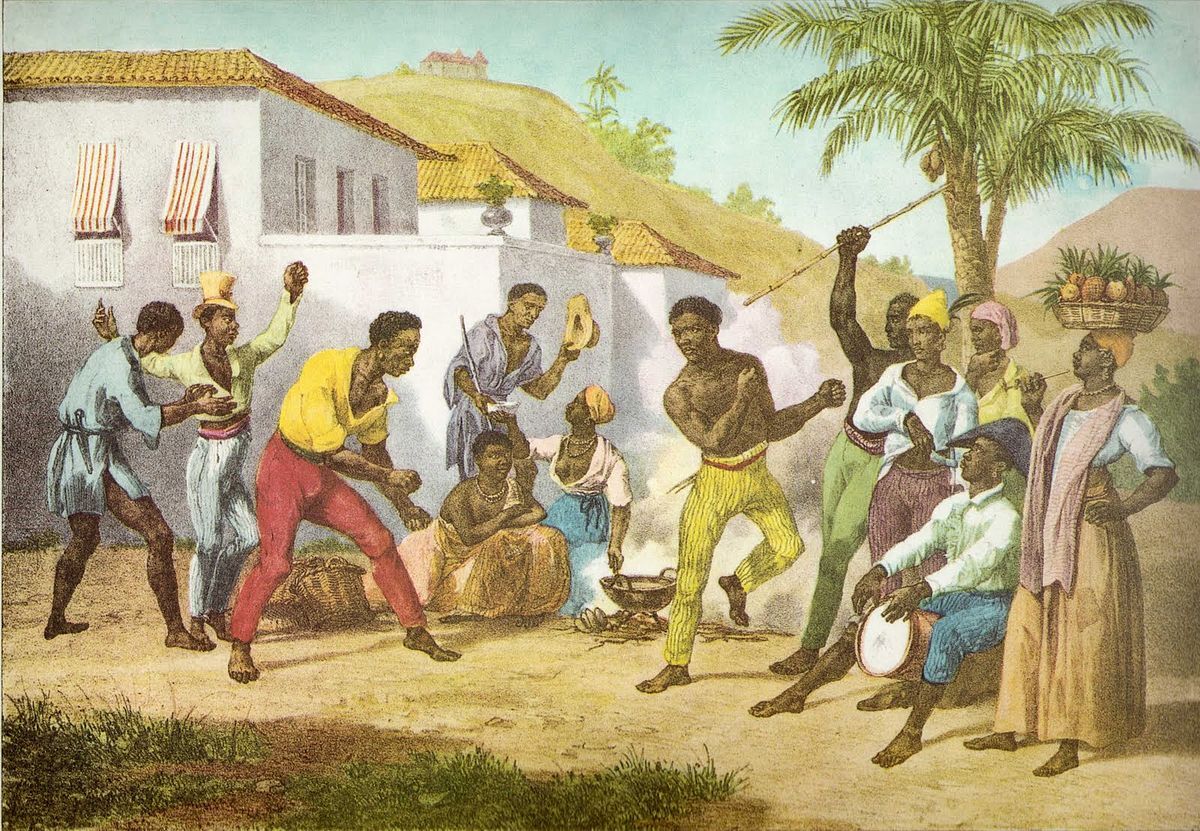
The berimbau’s roots trace back to African bow instruments, such as the mbulumbumba and other stringed bows used in traditional African music. These instruments were adapted in Brazil to suit the needs and resources of enslaved communities. Over time, the berimbau evolved into a symbol of resistance and identity, reflecting the resilience of Afro-Brazilian culture.
In the context of capoeira, the berimbau holds profound significance. It dictates the style and tempo of the game, whether slow and measured or fast and acrobatic. Beyond its musical role, the berimbau embodies the spirit of capoeira, blending artistry, rhythm, and struggle into a single thread.
Today, the berimbau is celebrated worldwide as a symbol of capoeira and Afro-Brazilian heritage. Its deep, resonant tones continue to tell stories of survival, unity, and freedom, making it an enduring emblem of cultural resistance and creativity. Through its music, the berimbau connects past traditions with contemporary expression, preserving a legacy of resilience and art.